损失函数
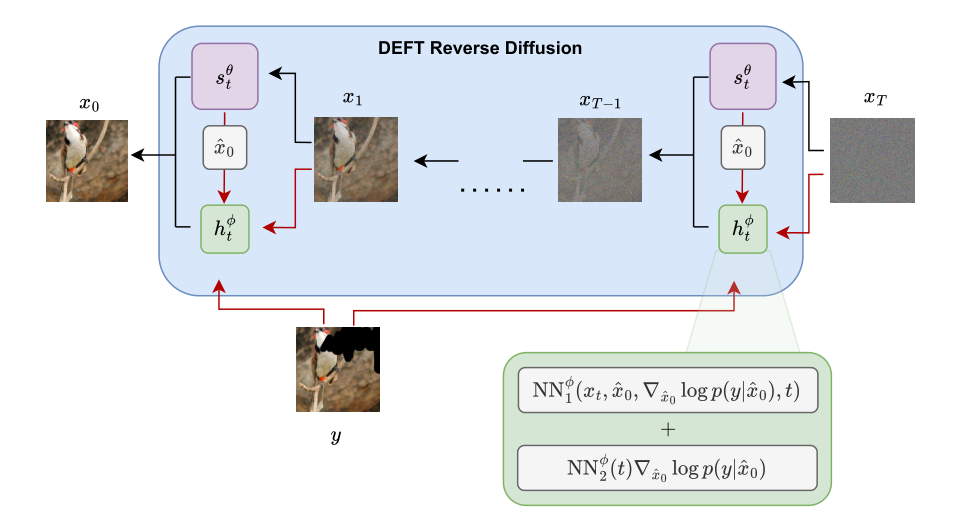
htransform/losses.py 按论文生成 \(\mathbf{x}_t\),冻结基础模型得到 \(\epsilon^\theta\) 和 \(\hat{\mathbf{x}}_0\),训练 \(\|\epsilon-(\epsilon^\theta+h^\phi)\|^2\)。
梯度边界
基础模型与条件特征构造包在 torch.no_grad(),符合“只训练 \(h\)-network”。phase retrieval 的近似 guidance 单独启用 autograd。
任务输入
inpainting 拼接 13 通道;super-resolution/HDR/CT/deblur 通常拼接 \(\mathbf{x}_t,\hat{\mathbf{x}}_0\) 与 cheap guidance;phase retrieval 加入两种粗反演。
数据选择
ImageNet 代码从 10k 列表每 10 张取一张形成 1k finetune set,每 100 张偏移一张形成约 100 张 validation set。论文的最终 1k evaluation 由单独 loader 列表提供。
公开范围
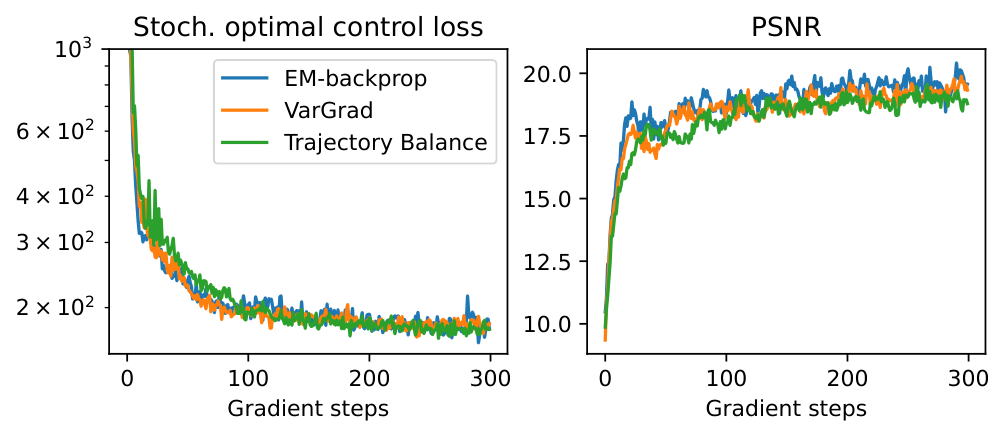
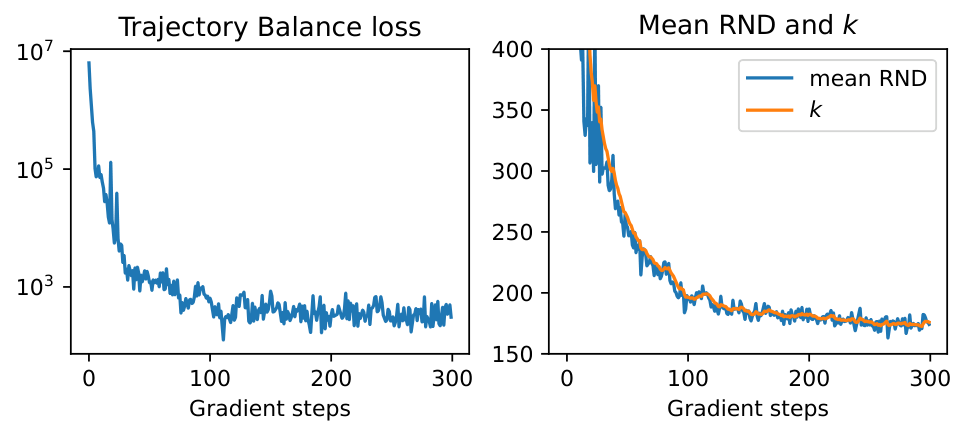
仓库没有 protein、Genie、motif、MNIST stochastic-control、VarGrad 或 Trajectory Balance 文件,也没有论文结果 checkpoint。
运行入口
README 的 super-resolution 命令对应重构后 main.py;inpainting 示例仍引用已不存在的 run_supervised_finetuning.py 与 configs/default_config.py。
默认配置
_configs/imagenet256_deft.yaml 引用缺失的 wandb_config/alexanderdenker.yaml;默认 finetune dataset root 是作者本机路径,使用者必须补齐。
噪声参数
论文 ImageNet task 描述为 noiseless,并为 inductive feature 使用 \(\sigma_y=1.0\) Gaussian approximation;代码 YAML 的 HDR/inpainting 默认 noise_std: 0.1,示例运行需要显式覆盖。
Residual 初值
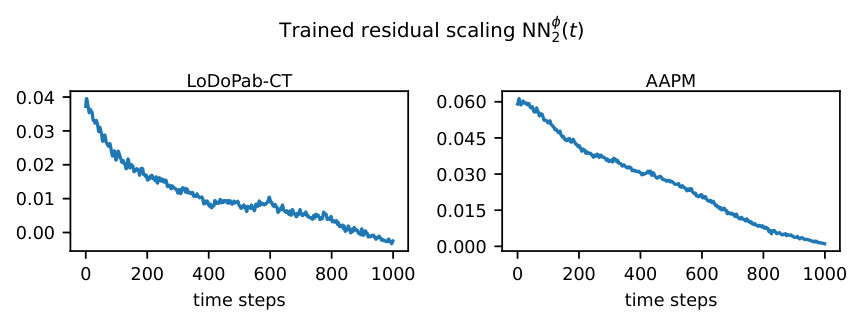
论文方法、附录、代码默认分别写 1、0.01、0.001;当前 epsilon 分支还对 time scaling 取负。
训练配置
公开 command 复现 SR4 的 batch 16、200 epochs、学习率 0.0005、100-step validation,并保留 “TODO: sample and eval with EMA model”。