01 · 论文身份与关键结论
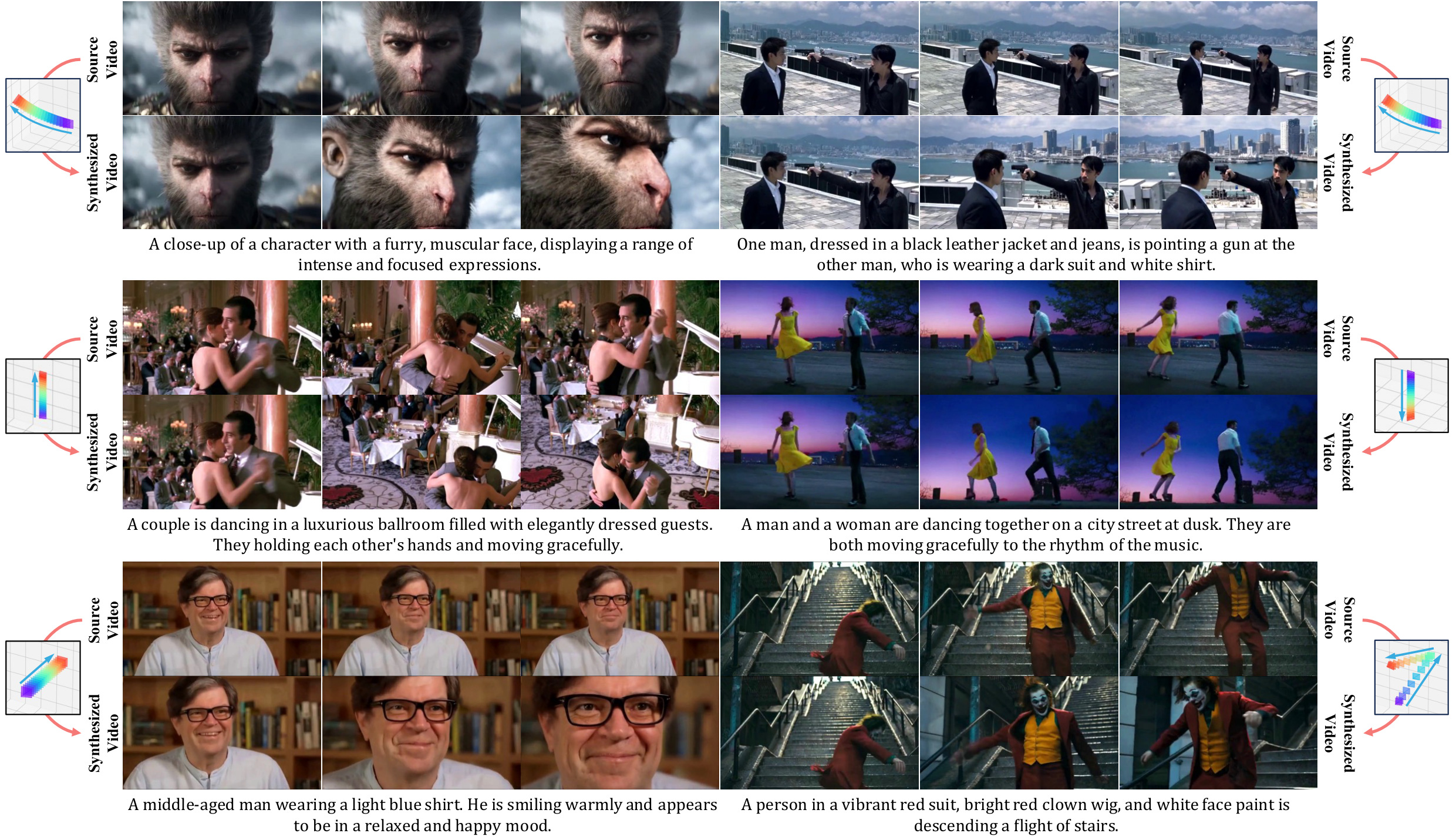
ReCamMaster 让已有视频换一种摄影机运动,同时尽量保留人物外观、动作进度和场景内容。核心是把源视频当作一整段可被注意力读取的条件 tokens,而不是先求精确 4D 重建,再从新相机渲染。
Paper verified 本页固定解析 2503.11647v1,2025-03-14:16 页合订 PDF,正文 1–8 页,致谢与参考文献 9–11 页,附录 12–16 页;完整覆盖原 Eq. 1–10、Figure 1–12、Table 1–5。正式发表为 ICCV 2025,页码 14834–14844;正式正文 11 页与独立补充 5 页仅用于版本交叉核查,新增结果明确标注。固定 PDF · 正式记录
作者顺序:Jianhong Bai、Menghan Xia、Xiao Fu、Xintao Wang、Lianrui Mu、Jinwen Cao、Zuozhu Liu、Haoji Hu、Xiang Bai、Pengfei Wan、Di Zhang。第一作者来自 Zhejiang University,工作在 KwaiVGI 实习期间完成;论文 † 明确通讯作者为 Menghan Xia 与 Haoji Hu。合作机构还包括 Kuaishou Technology、CUHK、HUST。原笔记的作者和通讯记录可保留,venue 与项目页可在后续归档补全。作者证据
方法
源/目标沿帧维拼接;每层注入目标相机 12 维外参;利用已有全时空 attention 建立对应。
数据
UE5 同步多机位渲染,论文口径 13.6K 动态场景、136K 视频、122K 轨迹;覆盖场景与摄影规则。
最大复现边界
论文使用内部 T2V 模型;公开版是 Wan2.1-T2V-1.3B 移植。官方明确不能保证达到论文结果。
阅读时必须分开的三件事:几何上真实的新视角、生成模型认为合理的新画面、与源动作同步的画面。本文主要优化后两者,自动相机与匹配指标提供辅助证据;未知区域仍可能被合理“补想”,没有物理真实性保证。官方开源说明
02 · 输入输出与目标
输入包括源视频 \(V_s\)、目标相机序列 \(C_{1:F}\) 和目标文本提示 \(p\);输出 \(V_{\mathrm{out}}\) 呈现同一动态场景在指定相机轨迹下的样子。论文符号 \(V_t\) 的下标表示 target,与扩散时间下标容易冲突;本页用 \(\tau\) 表示流时间、\(i\) 表示视频帧。
旋转矩阵 \(R_i\) 有 9 个存储值、平移 \(q_i\) 有 3 个,共 12 维表示;它对应 6DoF 位姿但不是 12 个独立物理自由度。模型没有要求用户提供源视频每帧相机,也没有深度、3D 点轨迹或 camera intrinsics 条件。源相机运动依靠网络从视频隐式理解。§4
| 约束 | 想保持什么 | 不等同于什么 |
|---|---|---|
| 外观一致 | 同一人物、服饰与场景的视觉特征 | 逐像素复制或法证级身份保证 |
| 动态同步 | 同时间戳动作阶段相同 | 仅相邻帧平滑 |
| 相机控制 | 输出运动接近目标外参轨迹 | 恢复唯一真实 3D 场景与精确尺度 |
| 新区域生成 | 填补新视角看到但源图未见的区域 | 被遮挡区域真实内容的观测证据 |
| 无需逐视频优化 | 训练好后前向多步采样 | 无需训练、单步生成或无计算成本 |
相比 GCD,作者希望提高真实域泛化;相比 ReCapture 的逐视频空间/时间 LoRA 优化,本文直接条件生成;相比显式 4D 重建或点轨迹条件方法,减少了跟踪错误的前置瓶颈。这里的优势仍取决于基础生成器和数据质量,并非证明重建方法没有价值。
03 · 多相机同步数据如何构造

每个动态场景由背景环境、人物资产、动画和相机集合组成。UE5 同时驱动同一段人物动作,让 10 个相机沿各自轨迹同步拍摄;训练随机选两路,一路为源,一路为目标。这样同时间戳的内容关系准确,无需在真实视频中匹配不同步的演员动作。
固定论文报告 40 个高质量 3D 环境、70 个人物模型、约 100 个动作,组合为 13.6K 动态场景,10 路相机得到 136K 视频和 122K 不同轨迹。环境来自 Fab,人物与动作来自 Fab/Mixamo;主要拟真,少量风格化或超现实。城市街道、商场、咖啡厅、办公室、乡村增强场景多样性。§3 · 附录 B
数据集总数不等于独立世界数量:136K 包括同一动态场景的 10 路观测。同一场景有 \(10\times9=90\) 个有向源—目标配对可供选择,但不是 90 个独立人物动作。本文并未报告把所有可能配对穷举训练,也没有给资产级隔离的 train/test 泛化划分。

公开数据发布口径与论文不同
| 项目 | 固定 v1 / 正式补充 | 官方发布 README / 数据卡 |
|---|---|---|
| 环境 / 人物 / 动画 | 40 / 70 / 约 100 | 37 / 66 / 93 |
| 动态场景 / 视频 | 13.6K / 136K | 13,600 / 136,000 |
| 不同相机轨迹 | 122K | HF 数据卡 112K;不能自行抹平 |
| 起始半球半径 | 10 m | 按场景取 3、5、7、10 m |
| pan / tilt | 5–60° / 5–45° | 5–45° / 5–30° |
| arc | 5–60° | 15–75° |
| 镜头参数 | 35mm f/2.8;24mm f/10 | 18mm f/10;24mm f/5;35mm f/2.4;50mm f/2.4 |
| 视频规格 | 固定正文未完整列出 | 1280×1280、81 帧、15 fps;可中心裁剪 |
| 传感器 | 未完整列出 | 23.76mm×23.76mm |
这些差异来自官方来源本身,可能反映发布子集或后续整理,但原因没有被明确证明。不能把数据卡覆盖论文训练口径,也不能声称已下载核算全量数据。本次仅读了卡片与结构。官方数据卡 · 固定仓库 README
04 · 摄影规则与速度模型
固定论文的起始位置在人物周围 10m 半球内采样,最近距离大于 0.5m,俯仰不超过 45°。pan 左右 5–60°,tilt 上下 5–45°;沿 xyz 正负方向平移距离为人物距离的四分之一到一倍;arc 转角 5–60°;随机路径选 1–3 个空间点、平滑折线;另含完全静止相机。内参虽在渲染时变化,但不输入本文相机 encoder。
这是原 Eq. 10。\(L_i\) 是第 \(i\) 帧位置,\(a\) 调速;\(a\gt0\) 先快后慢,\(a\lt0\) 先慢后快。50% 轨迹匀速,50% 变速。\(a=0\) 在原分式会 0/0,应取极限 \(i/F\) 得到匀速;这是数学补充,不能直接把零塞进未处理分母的代码。绝对值越大速度变化越强,不表示相机空间轨迹更长。
官方接口 10 类基础轨迹完整如下。它们是方便用户的预设,不等于训练只见这 10 条,也不能用“支持任意轨迹”掩盖极端超分布控制尚未量化。
| cam_type | 公开预设 |
|---|---|
| 1 | Pan Right |
| 2 | Pan Left |
| 3 | Tilt Up |
| 4 | Tilt Down |
| 5 | Zoom In |
| 6 | Zoom Out |
| 7 | Translate Up with rotation |
| 8 | Translate Down with rotation |
| 9 | Arc Left with rotation |
| 10 | Arc Right with rotation |
接口的 zoom-in/out 名称不能自动解释为光学焦距变化:模型只接收外参,因此实际控制信息描述相机运动而非显式焦距指令。物理 dolly 与光学 zoom 的透视不同,复现与应用应保留这个区分。推理输入
05 · 基础视频模型与 Rectified Flow

论文内部模型由 3D VAE 与 DiT 组成。VAE 压缩时间和空间;每个 block 含 spatial attention、全时空 3D attention、文本 cross-attention、FFN。附录说在 attention 或 FFN 前由 timestep 调制并应用 RMSNorm。模型参数规模、精确压缩比、层数及文本 encoder 未完整公开,不能拿 Wan2.1 的数字回填内部模型。
干净目标 latent 为 \(z_0\),噪声为 \(\epsilon\)。流路径从数据走向噪声,其速度是 \(\epsilon-z_0\)。这与 DDPM 的平方根方差 schedule 不同,不应把上一类扩散训练公式混进来。
\(\mathcal C=(V_s,C_{1:F},p)\) 是条件。论文 Eq. 3 用一般条件流匹配的向量场 \(u_\tau\) 记号;对于 Eq. 1 的直线路径,可以简化成这里的 \(\epsilon-z_0\)。代码 training_target 也采用该差值。没有像素重建 renderer、3D 重投影或显式点对应损失。§4.1 · flow scheduler
采样从 1 走向 0,所以增量为负。原 Eq. 4 的离散下标写法易混淆,此处显式写出有序时间表。方法不对每段输入重新训练,但仍要多步网络评估;“生成式渲染”是模型合成,不是传统渲染器对已知三维资产的确定性成像。
06 · 三种视频条件机制

令源、目标 latent 为 \(z_s,z_{\mathrm{tar}}\),目标先加噪。patchify 后 token 为 \(x_s,x_{\mathrm{tar}}\in\mathbb R^{B\times f\times s\times d}\),其中 \(f\) 是 latent 时间长度,\(s\) 是每帧空间 token 数。它们不应直接与像素帧数 \(F\)、像素面积混为一谈。
Channel dimension
在输入通道拼接,相当于每个时空位置把两个视图并排放入特征维。token 总数不增加,但源/目标不同视点的对应关系未必在同一个像素位置,输入投影必须学会解开混合。它并非理论上无法建立对应,只是本实验表现较弱。
View dimension
两条视频流分别处理,再加 view-attention 聚合同帧多视图信息。基模型已有 3D attention 仍在各自视频内工作,跨视频交互要经过新模块。Fig. 3 的冻结/训练配置也不同,因此不能把结果归因于一个“concat 运算符”而忽略模块和训练范围。
Frame dimension
本文把源和目标当同一序列里的两段时间 tokens,已有 3D attention 在所有时空位置之间交互,无需新增专门 view-attention。公开版实际存储顺序是 [target, source],论文图记 [source, target];训练、mask、输出切片与位置编码必须按各自实现保持一致,不能只交换一行拼接而不改其余逻辑。
Our interpretation 这种机制让目标任何时空位置读取源视频的相关细节,不要求先有显式光流或点跟踪。代价是 token 翻倍;若原 dense attention 用 \(N^2\) 交互,变为 \((2N)^2=4N^2\),线性层规模约翻倍。它是注意力交互项的理论量级,不等于实测总显存或总延迟精确变成四倍。
07 · 相机注入与坐标系
每个 block \(\ell\) 有 12→\(d\) 的线性 camera encoder。\(u\) 遍历该帧空间 tokens,同一帧相机 embedding 广播到所有位置;论文在 spatial-attention 后、3D-attention 前相加。它没有用每像素 Plücker rays,也没有深度投影,所以 spatial correspondence 必须由视频特征与注意力学习。§4.3
不输入源相机,是为了避免真实动态视频 SfM 估计不稳;不输入内参,是降低实际使用门槛。代价是相机外参和真实视觉尺度/焦距存在歧义。作者说可以扩展内参,但并未在本文报告 intrinsics-conditioned 实验。
公开版相机预处理
JSON 的 4×4 矩阵先 transpose,再按 [1,2,0,3] 重排列,将第二轴取负、平移除 100(厘米转米),然后做相对变换。训练读源首帧与目标每帧:若标准化后的 camera-to-world 为 \(C_s^0,C_t^i\),输入相对位姿是:
训练用源首帧确定坐标系,不代表把整个源相机轨迹喂给网络。推理预设则用目标轨迹自己的首帧为单位原点,因此第一帧相对位姿是 identity。没有源相机估计步骤;它暗含目标从输入初始视角出发的常用约定。外参的 camera-to-world / world-to-camera、行列存储和单位必须按代码核对,不能只看到 [R|t] 就套另一库约定。训练变换 · 推理变换
08 · 对原笔记 camera embedding 的逐项核对
原笔记抓住了关键:每层线性编码相机、扩到 token 尺寸、加到 self-attention 输入。其 3072 与忽略帧维的伪代码应当当作示意,而不是当前公开 Wan2.1-T2V-1.3B 的准确张量规范。本次不修改原代码与块锚点,在此补充可复核更正。
| 阶段 | 公开默认张量形状 | 含义 |
|---|---|---|
| 源视频 | B×3×81×480×832 | 81 原始帧 |
| VAE latent | B×16×21×60×104 | 时间约压缩 4、空间 8 |
| 目标 + 源 | B×16×42×60×104 | 沿 latent 时间拼接 |
| patch grid | 42×30×52 | patch_size=(1,2,2) |
| 相机 | B×21×12 | 每 4 原始帧取一次外参,含第 0 帧 |
| 线性编码 | B×21×1536 | 当前 1.3B backbone hidden dim |
| repeat(1,2,1) | B×42×1536 | 复制整段相机序列以匹配目标、源两个片段 |
| 空间广播 | B×42×30×52×1536 | 同帧 1560 个位置共享相机向量 |
| flatten | B×65520×1536 | 单视频 32760 tokens,联合 65520 |
四个细节:第一,当前脚本从 self-attn 权重读 dim,而不是硬编码 3072;1.3B config 为 dim 1536、30 blocks、12 heads、FFN dim 8960。第二,repeat 复制整个 21 帧序列,不是把每个相机交错重复两次。第三,30×52 写死,不能只改输入分辨率就预期无缝适配。第四,省略帧维的 B×d 张量直接执行 repeat(1,2,1) 并不等于通用的 B×2×d,因此原笔记的简化示意不宜直接运行。
cam:          [B, 21, 12]
linear(cam):  [B, 21, d]
repeat:       [B, 42, d]
broadcast:    [B, 42, 30, 52, d]
flatten:      [B, 65520, d]
input_x += camera_tokens
Wan block 在 LayerNorm 与 timestep modulation 后相加,再做 self-attn → projector → gated residual。它没有论文内部模型单独的 spatial-attention 层,属于移植结构。两段视频都加同一个目标相机序列:这不是把源镜头标注成目标镜头的几何 truth,而是实现中条件注入的设计。源码没有提供专门消融解释这一选择。block · 1.3B config
09 · 论文训练策略
每个同步场景的 10 路随机选两路,输入源视频、目标外参、目标 caption,监督目标 latent 的流速度。正文训练 10K steps、384×672、lr \(10^{-4}\)、batch 40。相机 encoder 和 projector 声称零初始化;只微调 camera encoder 和 3D attention 等新增相关模块,其余冻结,保留基模型泛化能力。Fig. 3 projector 标为可训练。
为减少 UE5 风格,训练向源条件 latent 加中等程度噪声,原文表示为 noise schedule steps 200–500。这个数字是其训练 schedule 的范围,不是“每段视频重复加噪 200–500 次”;源噪声和目标去噪 timestep 是不同概念,不能任意换成 20%–50% 高斯方差。
另外以 20% 概率完全替换源 latent 为高斯噪声,形成 T2V camera control;以 20% 概率只保留首帧、替换余下 \(f-1\) 帧,形成 I2V;其余主要为 V2V。意图是让模型在没有完整源视频时仍能生成合理新内容,减少对条件的机械复制。
这是对论文策略的统一表达,不擅自补充未公开的噪声 schedule 或是否在 I2V 首帧上再加噪的细节。冻结策略和 drop latent 有表格消融,源噪声的独立消融在后来的 ICCV Table 4 才补充。

Figure 9 同时展示 T2V、I2V、V2V;它验证统一接口的定性能力,不是三个任务各自的完整 benchmark。内部基础模型参数量、GPU 型号数量、训练耗时、optimizer、weight decay、warmup、全部采样超参数没有完整披露,不能从公开 Wan 脚本倒填。
10 · 公开训练路径与实质差异
Code verified 官方 README 明确论文模型受公司政策限制无法开放,故迁移到 Wan2.1。这里固定提交 fcf98bc86e876bb534518cd99e8a65b282f0f16e,读源码而不运行模型。
| 项目 | 论文 | 公开版 |
|---|---|---|
| 基础模型 | 内部 T2V | Wan2.1-T2V-1.3B,UMT5-XXL、Wan VAE |
| 训练尺寸 | 384×672 | 480×832,81 帧 |
| batch | 40 | 每 GPU 1;示例 8 GPU、accumulate 1 |
| 步数 | 10K | 发布 checkpoint 名 step20000;README 命令 steps_per_epoch 8000、max_epochs 100,不是 10K 等价运行 |
| 优化器 | 未明确 | AdamW,命令 lr 1e−4;未单独指定 betas、weight decay |
| 精度 | 未完整披露 | bf16,支持 gradient checkpointing / offload |
| camera 初始化 | 零初始化 | weight/bias 置零 |
| projector 初始化 | 正文说零初始化 | weight identity,bias zero |
| 源条件 | 中等噪声,20% T2V、20% I2V | 训练对全部加噪后将 source 半段恢复干净;默认代码没有相应噪声/drop 分支 |
| 更新范围 | 3D-attn 与新增条件模块 | cam_encoder、projector、self_attn;其余冻结 |
数据先缓存 VAE latent 与文本 embedding;训练读取目标一路,再随机选不同相机作为源,沿时间拼接 [target, source]。使用目标 caption,只监督前半段 target 的流预测,source 输出被丢弃。数据读取异常会 while True 随机重抽,不是固定失败退出;正式训练应统计坏样本,否则可掩盖目录或相机解析问题。
源码对 source 半段恢复干净,target 半段算 MSE,并乘 scheduler 的时间权重。训练随机一个 timestep 应用于当前 batch。它不是完整复现论文的 source noise/drop 训练策略,不能据此断言公开 checkpoint 同样支持论文全部统一任务。保存函数会存完整 DiT state_dict;不是仅存 LoRA,也不是仅存可训练参数列表。模型和训练
公开 scheduler 的 \(\sigma\) 用 shift 5 做变换 \(\sigma'=5\sigma/(1+4\sigma)\),流目标为 noise−sample;推理更新使用相邻 sigma 差。训练有额外 loss weight,不应把论文未写明的权重说成内部模型参数。
11 · 推理输入与默认行为
官方脚本要求每段至少 81 帧视频、metadata.csv 的 file_name 和 text 两列、目标相机预设。默认取前 81 帧、interval 1;先按比例放大到覆盖 480×832,再中心裁剪,不是直接拉伸。相机每 4 帧采一次,得到 21 个 latent 时间位置。更长视频不会自动滑窗完整处理。
- 加载 Wan2.1-T2V-1.3B、UMT5-XXL 文本 encoder、Wan VAE,再加载 ReCamMaster DiT checkpoint
- 源视频 VAE 编码成固定条件 latent;目标从高斯噪声初始化
- 读取目标相机,单位与轴变换后转换相对外参,展平 12 维
- 编码正向 caption 与负向提示,准备每个 block 的相机条件
- 50 步采样,每步拼 [target, source];预测后只更新目标半段,源条件始终固定
- 解码目标 latent 得到 81 帧;脚本以 30 fps 保存 mp4
公开数据卡视频是 15 fps,而推理保存默认 30 fps。若不改时间采样或输出 fps,同样 81 帧的播放时长和动作速度就与 15 fps 源不同;不能仅对齐帧索引就宣称保持真实时间轴。81/30 约 2.7 秒、81/15 约 5.4 秒是文件帧数除帧率的时长近似,不是模型新增了插帧。官方入口
默认 seed 0、50 步、sigma shift 5、bf16、tiled VAE。这里正负分支共享源视频和相机,只改变文本条件;CFG 不是源视频保真强度的独立旋钮。实际命令未开启有效 TeaCache:model_fn 内部直接将 tea_cache 置为 None,不能因为接口有缓存参数就宣称获得加速。
python inference_recammaster.py --cam_type 1 --dataset_path path/to/data --cfg_scale 5路径陷阱:dataset_path 改视频和 caption 路径,相机 JSON 却硬编码为 ./example_test_data/cameras/camera_extrinsics.json。要使用自定义轨迹需核对代码读取目的地,不能只在新数据目录放一个相机文件就认为它会生效。30×52 广播还限制默认分辨率;扩展长视频、其他比例和多 batch 必须同步重构形状逻辑。
负向提示与示例 caption
官方脚本负向提示原文完整如下,这是开源移植版的生成条件,不是论文内部模型披露的统一提示词:
色调艳丽,过曝,静态,细节模糊不清,字幕,风格,作品,画作,画面,静止,整体发灰,最差质量,低质量,JPEG压缩残留,丑陋的,残缺的,多余的手指,画得不好的手部,画得不好的脸部,畸形的,毁容的,形态畸形的肢体,手指融合,静止不动的画面,杂乱的背景,三条腿,背景人很多,倒着走页面末尾保留官方 10 个示例 caption 全文。它们来自公开样例,不是 WebVid 1000 例评价的完整提示集合。README 允许用视频 caption 工具准备文本,但没有公开论文全部 caption 生成模板、模型版本和过滤流程,不得替作者补造。
12 · 评价协议与指标含义
测试选 WebVid 随机 1000 视频与 10 类相机轨迹,包括 pan、tilt、垂直移动、进退和水平 arc。作者选择与 baseline 常见轨迹接近的控制方式,以减少比较偏差。原文没有足够清楚地说明所有 1000×10 组合是否全部生成及每例 seed 数,不能未经确认直接写成 10,000 段或 best-of-N。
| 维度 | 指标 | 计算对象 / 方向 | 局限 |
|---|---|---|---|
| 视觉保真 | FID、FVD | 生成图像/视频分布,越低越好 | 参考集合、特征版本、帧采样需完整固定;不能还原一对一真实新视角误差 |
| 文字一致 | CLIP-T | 帧与文本平均相似度,越高越好 | 场景语义正确不等于身份或几何正确 |
| 时间连贯 | CLIP-F | 相邻帧相似度,越高越好 | 过静态也可能很高,不等于运动正确 |
| 相机精度 | RotErr、TransErr | GLOMAP 估计生成视频相机后与控制目标比较,越低越好 | 估计器可受动态对象影响;坐标对齐、单位和失败处理未完整披露 |
| 源目标同步 | Mat. Pix.(K) | GIM 匹配置信度超阈值的匹配像素数,越高越好 | 阈值和聚合方式未完整给出;不能当正确几何比例 |
| 跨视视频一致 | FVD-V | 借鉴 SV4D 的跨视视频差异,越低越好 | 不提供每像素对应的保证,需同协议实现 |
| 同时间戳外观 | CLIP-V | 源/目标同帧语义相似度,越高越好 | 不直接测 3D 或动作细节 |
§5.1。论文仅给相机误差和 GIM 评价的概括,所检查公开版没有提供能复现整张论文表的完整统一评价配置。本页不擅自为 RotErr 填“度”、为 TransErr 填“米”,也不猜 GIM 阈值。Mat. Pix. 的 K 保留原表单位,但不能把跨帧聚合数解释成单帧像素覆盖率。
这里以比例符号表达平均相似度关系,具体分数缩放和 backbone 以评价实现为准,不擅自补成概率。两者不能互换:相邻输出平滑可能仍与源动作错拍。
VBench 另报告审美、成像质量、temporal flickering、motion smoothness、subject consistency、background consistency,表中均是“高更好”的评分。Temporal Flickering 名字像错误量,但数值方向是分数上升代表更好,不能反读。
Reviewer 单目相机估计并非真实相机 ground truth;生成器也可能改变几何来迎合视觉运动。最强结论应同时满足相机控制、同时间戳匹配与视觉质量,而不是只抓最高 CLIP。论文未报告人类研究、置信区间、跨 seed 方差或统一推理算力比较。
13 · 完整 SOTA 比较
GCD 使用 Kubric 合成训练对,真实域差距较大;Trajectory-Attention 与 DaS 依赖从源视频提取的 3D 点轨迹等结构条件。ReCapture 是讨论的重要相关方法,但不在固定 v1 的主结果表中,不能把它添加成有数值比较的一行。本文对比还混合了不同 backbone 与训练数据,优势不能全部归因于 concat。
原 Table 1 · 视觉、相机与同步全部指标
| Method | Visual Quality | Camera Accuracy | View Synchronization | ||||||
| FID \(\downarrow\) | FVD \(\downarrow\) | CLIP-T \(\uparrow\) | CLIP-F \(\uparrow\) | RotErr \(\downarrow\) | TransErr \(\downarrow\) | Mat. Pix.(K) \(\uparrow\) | FVD-V \(\downarrow\) | CLIP-V \(\uparrow\) | |
| GCD | 72.83 | 367.32 | 32.86 | 95.66 | 2.27 | 5.51 | 639.39 | 365.75 | 85.92 |
| Trajectory-Attention | 69.21 | 276.06 | 33.43 | 96.52 | 2.18 | 5.32 | 619.13 | 256.30 | 88.65 |
| DaS | 63.25 | 159.60 | 33.05 | 98.32 | 1.45 | 5.59 | 633.53 | 154.25 | 87.33 |
| ReCamMaster | 57.10 | 122.74 | 34.53 | 98.74 | 1.22 | 4.85 | 906.03 | 90.38 | 90.36 |
与 DaS 相比:FID 63.25→57.10(下降约 9.7%),FVD 159.60→122.74(下降约 23.1%),FVD-V 154.25→90.38(下降约 41.4%);Mat. Pix. 633.53K→906.03K(增加约 43.0%),RotErr 1.45→1.22、TransErr 5.59→4.85。百分比仅表示这些指标的数值变化,不是物理真实性提升的百分比。
原 Table 2 · 完整 VBench 子项
| Method | Aesthetic Quality \(\uparrow\) | Imaging Quality \(\uparrow\) | Temporal Flickering \(\uparrow\) | Motion Smoothness \(\uparrow\) | Subject Consistency \(\uparrow\) | Background Consistency \(\uparrow\) |
| GCD | 38.21 | 41.56 | 95.81 | 98.37 | 88.94 | 92.00 |
| Trajectory-Attention | 38.50 | 51.00 | 95.52 | 98.21 | 90.60 | 92.83 |
| DaS | 39.86 | 51.55 | 97.44 | 99.14 | 90.34 | 92.03 |
| ReCamMaster | 42.70 | 53.97 | 97.36 | 99.28 | 92.05 | 93.83 |
Table 2 的重要例外:DaS 的 Temporal Flickering 97.44 高于本文 97.36。本文在其他五列最好,不能写成所有 VBench 子项都赢。Motion Smoothness 已在 98–99 的高区间,没有误差条时细小差异不能当成显著性证明。

Figure 4 显示人物、服装、动作与背景在新视角的保持。静态 montage 不能完整证明时间同步;视频结果应在后续实际播放时核验,本次按用户要求未做浏览器播放或视觉验收。

Figure 12 提供额外方法比较,没有增加独立量化设置;展示样例仍可能有选择偏差。
14 · 条件机制消融
原 Table 3 · 条件机制比较
| Method | Visual Quality | Camera Accuracy | View Synchronization | ||||||
| FID \(\downarrow\) | FVD \(\downarrow\) | CLIP-T \(\uparrow\) | CLIP-F \(\uparrow\) | RotErr \(\downarrow\) | TransErr \(\downarrow\) | Mat. Pix.(K) \(\uparrow\) | FVD-V \(\downarrow\) | CLIP-V \(\uparrow\) | |
| Channel dim. | 74.09 | 187.94 | 33.70 | 98.67 | 1.28 | 4.98 | 521.10 | 148.51 | 84.62 |
| View dim. | 80.51 | 194.47 | 34.66 | 98.71 | 1.42 | 5.77 | 573.92 | 177.68 | 83.40 |
| Frame dim. (ours) | 57.10 | 122.74 | 34.53 | 98.74 | 1.22 | 4.85 | 906.03 | 90.38 | 90.36 |

作者保持相机注入、数据与训练步数不变,比较 channel、view、frame 三种机制。Frame 相比 channel:FVD 187.94→122.74,下降约 34.7%;匹配像素 521.10K→906.03K,提高约 73.9%;FVD-V 148.51→90.38,CLIP-V 84.62→90.36。说明跨时空源条件利用是重要因素。
例外:View 的 CLIP-T 34.66 高于 Frame 的 34.53,所以不是所有列最佳。View 与 Frame 的 CLIP-F 接近,但同步指标差别大,也说明仅相邻帧平滑不是充分条件。
Figure 5 的 channel/view 结果有更明显合成渲染风格和动作错位,Frame 更贴近源。作者把原因归于每层全时空交互。这个解释有合理机制,但图 3 的可训练模块数、token 量和计算预算也不同;消融并非严格 equal-FLOPs 或 equal-parameters。应把“此设计组合有效”与“数学上唯一最优 concat 维度”分开。
15 · 训练消融与正式版补充
原 Table 4 · 固定 v1 训练策略消融
| Method | FID \(\downarrow\) | FVD \(\downarrow\) | Aesthetic Quality \(\uparrow\) | Imaging Quality \(\uparrow\) |
| Baseline | 66.67 | 171.80 | 40.02 | 51.93 |
| + 3D-Attn. tuning | 59.47 | 132.58 | 43.08 | 52.80 |
| + Drop latent | 62.39 | 149.52 | 41.47 | 52.65 |
| + Both | 57.10 | 122.74 | 42.70 | 53.97 |
固定 v1 Table 4 的 Baseline 是常规重建训练;+3D-Attn tuning 指局部更新、冻结其他模块;+Drop latent 指统一任务的源 latent 丢弃;+Both 是两者组合。FID 66.67→57.10,FVD 171.80→122.74,说明总体视觉质量改善。
审美列并非组合最佳:仅 3D-attn tuning 的 43.08 高于 Both 的 42.70。组合最好的是 FID、FVD、Imaging Quality,不能把“best performance”读成逐列全胜。v1 没把 source noise augmentation 单列出来,因此单凭 v1 Table 4 无法分离噪声项效应。
正式 ICCV Table 4 · 新增加噪行
| Method | FID ↓ | FVD ↓ | Aesthetic Quality ↑ | Imaging Quality ↑ |
|---|---|---|---|---|
| Baseline | 66.67 | 171.80 | 40.02 | 51.93 |
| + Add noise | 65.17 | 164.04 | 40.36 | 52.22 |
| + 3D-Attn. tuning | 59.47 | 132.58 | 43.08 | 52.80 |
| + Drop latent | 62.39 | 149.52 | 41.47 | 52.65 |
| + All | 57.10 | 122.74 | 42.70 | 53.97 |
正式 ICCV Table 4 新增 +Add noise:FID 65.17、FVD 164.04、Aesthetic 40.36、Imaging 52.22;最后一行改名 +All,数值仍为 57.10、122.74、42.70、53.97。它补强了噪声策略的独立证据,但不改变“审美并非全组合最大”的事实。本页完整保留新表,并不悄悄替换固定 v1 原表。正式版 Table 4
未提供多随机种子和置信区间,也没有把 noise、tuning、drop 做完整三因素组合矩阵。公开训练缺少论文噪声/drop 路径进一步限制了直接数值复现,不能仅拿 step20000 权重就把正式论文表格视为已复现。
16 · 数据构造消融
原 Table 5 · 训练数据构造消融
| Dataset | Visual Quality | Camera Accuracy | View Synchronization | ||||||
| FID \(\downarrow\) | FVD \(\downarrow\) | CLIP-T \(\uparrow\) | CLIP-F \(\uparrow\) | RotErr \(\downarrow\) | TransErr \(\downarrow\) | Mat. Pix.(K) \(\uparrow\) | FVD-V \(\downarrow\) | CLIP-V \(\uparrow\) | |
| Toy Data | 69.35 | 179.22 | 34.28 | 98.77 | 1.98 | 5.24 | 862.59 | 89.58 | 89.70 |
| High-Quality Data | 57.10 | 122.74 | 34.53 | 98.74 | 1.22 | 4.85 | 906.03 | 90.38 | 90.36 |
Toy Data:单一 3D 环境、500 个动态场景、手工 20 轨迹、5,000 路相机视频。High-Quality Data:40 环境、13.6K 动态场景、136K 视频、122K 轨迹。高质量集 FVD 179.22→122.74,下降约 31.5%;RotErr 1.98→1.22;CLIP-V 89.70→90.36,显示更好的真实域生成和相机覆盖。
两个反例必须保留:Toy CLIP-F 98.77 略高于高质量集 98.74;Toy FVD-V 89.58 略低于 90.38。Table 5 不支持所有同步/连贯指标都改善。它同时改变环境多样性、轨迹多样性、样本规模和拟真程度,不能单独认定增益完全来自“更真实的 UE5 画质”。
更有解释力的实验应固定样本数与场景资产,分别改变轨迹范围、环境数、渲染风格与速度变化;再测试未见场景、未见动作和未见相机模式。本建议是研究延伸,不是论文已提供的额外结果。
17 · 应用、首帧假设与失败案例

稳定化:在 DeepStab 抖动视频上给更平滑的相机轨迹,可产生更稳定的观感。本文没有报告传统稳定化指标、保真误差或与完整专用基线的量化对照;生成器也可能改变原内容,不能替代要求原始证据保存的稳像。
局部超分:用 zoom-in 轨迹生成更多局部细节,属于生成式近景补充,不是从传感器恢复可验证高频内容;没有 PSNR/SSIM 或实测高分辨率 ground truth。Outpainting:zoom-out 生成原画面之外的腿脚、地面等区域,未见内容属于模型推断。

固定 v1 Figure 11 扩充生成例子。更多好看的样例不直接提供 long-video consistency、分辨率扩展或任意相机大转角的成功率。
正式补充新增:非重合首帧
ICCV supplement 明确说主实验默认生成首帧与源首帧重合。为了测试不同初始视角,又渲染 27K 非重合首帧视频作为训练数据,并展示新结果。因此该扩展不是证明原始模型无需额外训练即可从任意初始视角开始;这是一组新增训练数据支持的定性泛化实验。正式补充 C.4
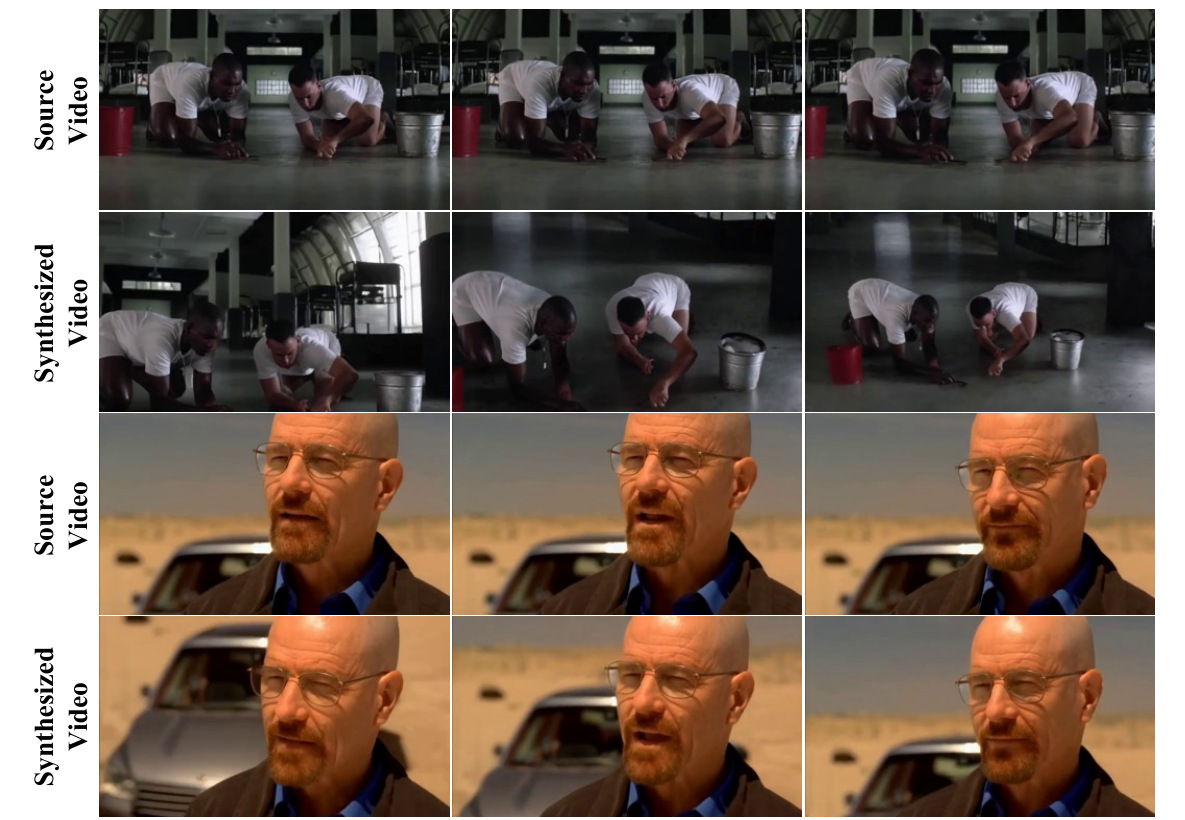
此图为正式补充 Figure 10,固定 v1 的 Figure 10 则是失败案例。两版后续编号发生偏移,本页均注明版本。

v1 失败案例包含手部动作质量差、小物体生成失败,继承基础 T2V 模型限制。重拍运动越大,新出现区域越多,模型需要猜测越多;文本、源视频和相机指令冲突时也未有硬约束保证。
作者项目页提供复杂折线、稳定化等视频;本页可追溯 官方视频集。本次未播放,不把 HTTP 获取或静态图误称为视频质量验收。
18 · 实现审计与复现风险
| 差异或假设 | 证据 | 影响 |
|---|---|---|
| 内部模型与开源模型不同 | README 明确 Wan2.1 移植 | 不能把论文数字归给公开 1.3B checkpoint |
| 12→d 而非固定 3072 | dim 从实际 self-attn 权重读取,1.3B config 为 1536 | 原笔记数值只保留作历史示意 |
| 30×52 网格写死 | block 的相机 broadcast | 改分辨率需同步改代码,不能仅改 pipeline 参数 |
| target/source 顺序 | 训练和采样都是 target 前、source 后 | 切片、loss、camera repeat、RoPE 必须一致 |
| projector | 代码 identity,论文 zero | 起点函数和早期梯度不同 |
| 条件噪声与 latent drop | 公开 training_step 没有对应策略,恢复干净 source | 公开默认不等同论文统一任务训练 |
| 相机 JSON 路径 | 推理硬编码 example_test_data | 更换 dataset_path 不会自动换相机 |
| 播放时间 | 数据卡 15 fps,保存 30 fps | 必须显式处理时间轴和真实速度 |
| TeaCache | model_fn 将变量置 None | 存在接口不代表实际加速 |
| 训练错误恢复 | while True 随机重抽坏样本 | 需日志统计,避免系统性漏数据 |
| 模型大小扩展 | 源码含 14B 配置/通用接口 | 不能据此声称已训练或评价 ReCamMaster 14B |
| 发布数据规格 | 论文 40/70/100、122K;数据卡 37/66/93、112K | 需要明确版本,不自行合并口径 |
公开版完整 caption 示例在后文;论文评估集 caption 和相机误差对齐细节不全。权重文件名 step20000 不证明训练中所有配置,也不等于固定 v1 的 10K steps。本文未下载 GPU 权重、数据集视频包,未执行训练、采样或评价。
官方仓库代码 LICENSE 为 MIT,官方模型卡和数据卡标记 Apache-2.0;三者须分开记录。上游 Wan、真实视频、Fab/Mixamo 原始资产可能有各自使用条件,不能把数据卡许可扩大成任意源资产再分发许可。这里仅作来源与复现注意,不作法律结论。代码许可 · 模型卡
19 · Reviewer 评价
强项
本文把动态同步数据与条件机制一起设计,避免只加入相机 embedding 却忽略源视频注入。帧维拼接复用了全时空 attention,能在各层建立跨视频联系;对 channel/view 条件有定量消融。多机位 UE5 数据提供精确同步和位姿,解决现实采集昂贵的问题。公开迁移版及训练代码有实际研究价值,作者也明确披露与内部模型性能不同。
证据缺口
- 相机真实性:输出估计相机与目标相近,不等于世界几何正确,动态人物还会干扰 SfM
- 遮挡未知:背面、画外区域没有真实监督于测试视频,可能合理但虚构
- 数据消融混杂:规模、环境、轨迹、画质同时变,因果贡献难分
- 跨方法公平性:基模型、数据、可训练参数、算力不同;内部模型不能完整开放
- 扩展能力:长视频、高分辨率、不同时间采样和极端相机路径未完整量化
- 统计性:无置信区间、显著性、全失败统计和人类研究
- 评价完整性:GIM 阈值、相机尺度/坐标对齐、SfM 失败处理等复现信息不足
有价值的下一步
把 frame 与其他条件方式在同 backbone、同参数预算或同 FLOPs 下比较;按相机角度、遮挡比例、动作速度分桶;用合成测试提供真实新视角和深度,分别测相机、几何、身份、同步。再做视频往返重拍与闭环相机轨迹,检查场景是否出现不可逆漂移。
应明确“源视频保持”与“生成新内容”的竞争关系,设计不确定性或可见性标记,让不可观测区域与有输入支撑区域分开。对于新闻、医疗、自动驾驶等需要真实性的应用,不应把生成新视角当作新的实际观测。
20 · 对材质与程序生成的研究启发
Research extension ReCamMaster 不生成材质图、shader、PBR 参数或可执行程序,也没有 differentiable renderer。以下是将其思想移到 PMG 的可检验设想,不能视为论文已验证。
让参考保留自己的 tokens
与 channel 拼接相比,保留源视频独立 token 序列让生成目标可在任意位置读取条件。PMG 可以给多视角参考渲染、局部 patch、已有子图分别保留 token 类型和位置标签,而非在输入层压成一个混合向量。但必须用类型、域和视角编码避免参考图片与程序 tokens 混淆。
\(C,L\) 是相机与光照。本文不输入 intrinsics 的实用取舍不应照搬:材质拟合需要区分透视、尺度、照明和反射,否则高光位置可能被烘焙进纹理。
合成数据必须同步改变观测,不改变材质本体
借鉴同一动态场景的同步相机,固定一个程序材质 \(G\),从多相机、多光照、多几何渲染,组成有确切对应关系的训练组。不同视角下的同一参数是比单幅图更强的约束;同时保持参数、节点图和渲染元数据,以避免网络仅记住图像风格。
\(\mathcal M_k\) 是几何;执行有效性包含端口类型、DAG、参数范围、支持节点、无悬空引用。视频一致并不保证图程序合法,因此必须单独执行检查。
从条件丢弃到多任务材质补全
参考全丢可训练 text-to-material,仅留一视角可训练 image-to-material,完整多视角可训练 inverse material;保留旧子图形成局部编辑。丢弃策略应保持任务标签、可见性和 renderer 元数据,不能让模型将不同观察条件当成同一种物理证据。公开 ReCamMaster 没实现论文的全部 drop 分支也提醒:必须在代码与实验上验证真正训练到了这些模式。
闭环评测比单张漂亮图更重要
| 假设 | 最小实验 | 报告项 | 否证条件 |
|---|---|---|---|
| 独立参考 tokens 改善材质细节 | channel 混合 / token 拼接,同计算预算 | 纹理谱、尺度、各向异性、多光照误差 | 只提高 CLIP,换光照失败 |
| 同步多视图减少外观捷径 | 单视图 / 多视图固定样本量 | 参数误差、跨几何泛化、bitmap 依赖 | 仍把阴影存进 base color |
| 条件 drop 支持缺失参考 | 任务混合比与独立模型对照 | 各任务质量、执行率、旧子图保留 | 统一模型只改善一个任务 |
| 几何与照明条件有益 | 仅外参 / 外参+内参+光照 | 重投影、高光一致、闭环渲染误差 | 相机动得像但反射模型错误 |
最重要的边界:对于视频,合理补想是可接受创作;对于逆向材质,必须把不确定解空间与观测解释清楚。应输出可编辑程序与可复现渲染验证,而不是让生成器的视觉先验替代物理证据。
21 · 官方提示词与来源清单
以下 10 个 caption 是官方 example_test_data/metadata.csv 全文,按视频名保留;它们是开源样例的输入,不是论文 1000 视频评价集的完整 prompts。没有替作者补造 system prompt、captioner 配置或思维链。
1.mp4 · 官方示例 caption 全文
A man and a woman are dancing together on a city street at dusk. The woman is wearing a yellow dress with a floral pattern and black shoes, while the man is dressed in a white shirt, dark tie, and dark pants with black shoes. They are both moving gracefully to the rhythm of the music, with the woman twirling and the man following her steps. The background features a cityscape with buildings and a distant mountain range, illuminated by the setting sun, creating a warm and romantic atmosphere. The main subjects are a man and a woman. The woman is wearing a yellow dress with a floral pattern and black shoes, while the man is dressed in a white shirt, dark tie, and dark pants with black shoes. They are dancing closely together, with the woman often twirling and the man following her movements. Their expressions and body language suggest they are enjoying the dance and are in sync with each other. The woman's movements are fluid and expressive, involving twirls and spins. The man follows her lead, moving in sync with her steps. Their dance is characterized by moderate to fast-paced movements, with the woman often leading the way. The background remains static, emphasizing the dynamic nature of their dance.
2.mp4 · 官方示例 caption 全文
A person dressed in a vibrant red suit with a yellow vest and a green shirt is seen descending a flight of stairs. The individual's attire is complemented by a bright red clown wig and a white face paint with black accents, resembling a classic clown makeup. The person's movements are dynamic and exaggerated, with arms flailing and legs kicking, suggesting a sense of urgency or excitement. The setting appears to be an urban environment, with the staircase leading to a brightly lit outdoor area, possibly a street or a public space. The person's actions are the focal point, with the background remaining static and out of focus.
3.mp4 · 官方示例 caption 全文
A man and a woman sit on a wooden bench in a park, engrossed in their respective activities. The man, dressed in a light blue suit with a white shirt and red tie, holds a clipboard and appears to be reading from it. The woman, wearing a white dress with a pink cardigan and white shoes, is reading a magazine. The scene is set in a sunny park with lush green grass, trees, and statues in the background. The main subjects are a man and a woman sitting on a wooden bench. The man is dressed in a light blue suit, white shirt, and red tie, holding a clipboard and reading from it. The woman is wearing a white dress with a pink cardigan and white shoes, reading a magazine. They are positioned side by side on the bench, with the man on the right and the woman on the left. The man occasionally points at something, possibly explaining or discussing it with the woman. The background features a park setting with green grass, trees, and statues. There are several people walking in the background, and a few cars are parked nearby. The scene is set during the daytime with bright sunlight casting shadows on the ground. The park appears well-maintained and serene, with a mix of natural and man-made elements.
4.mp4 · 官方示例 caption 全文
A man in a plaid suit jacket, white shirt, and dark tie is seen smoking a cigarette while standing next to a white police car. He is engaged in a conversation with someone off-camera, gesturing with his hands and occasionally looking at his watch. The scene takes place in an outdoor setting with several other people in the background, some of whom are dressed in formal attire. The man's movements are deliberate and expressive, involving hand gestures and occasional glances at his watch. The background remains static, with no significant changes or movements. The main subject is a man in his 40s, wearing a plaid suit jacket, white shirt, dark tie, and dark belt. He is holding a cigarette in his right hand and is seen smoking it while talking. His left hand is often raised, gesturing as he speaks. He is positioned next to a white police car, with his back to the vehicle. The man's movements are animated, involving hand gestures and occasional glances at his watch. The camera is stationary, capturing the scene from a medium shot that includes both the man and the police car in the frame.
5.mp4 · 官方示例 caption 全文
A couple is dancing in a luxurious ballroom filled with elegantly dressed guests. The man, dressed in a gray suit, and the woman, wearing a black dress, are dancing closely together, holding each other's hands and moving gracefully. The atmosphere is sophisticated, with a backdrop of elegant chandeliers, ornate decorations, and a crowd of well-dressed people enjoying the event. The couple's movements are smooth and rhythmic, with the woman's hair flowing as they twirl and sway. The background is a luxurious ballroom with ornate decorations, including chandeliers, potted plants, and elegant furniture. The room is filled with well-dressed guests, some of whom are seated at tables, while others are standing and mingling. The setting suggests a formal event, possibly a gala or a high-end party, with a focus on elegance and sophistication. The main subjects are a man and a woman dancing together. The man has dark hair and a mustache, wearing a gray suit, and the woman has her hair styled in an updo, wearing a black dress. They are holding hands and moving in close proximity, with the woman's back facing the camera at times. Their movements are fluid and synchronized, indicating a comfortable and intimate connection.
6.mp4 · 官方示例 caption 全文
A couple is seen on the deck of a large ship, embracing and enjoying a romantic moment as the ship sails through the ocean. The woman, dressed in a black dress with a white shawl, and the man, wearing a black jacket and pants, are holding each other tightly, with the woman's arms wrapped around the man's neck and the man's arms around the woman's waist. They are positioned near the railing of the ship, with the ocean and the ship's structure in the background. The scene captures the warmth and intimacy of their embrace as they look out towards the horizon, with the sun setting in the background, casting a golden hue over the entire scene. The main subjects are a couple, a woman, and a man. The woman is wearing a black dress with a white shawl, and the man is dressed in a black jacket and pants. They are standing close to each other, with the woman's arms wrapped around the man's neck and the man's arms around the woman's waist. They are positioned near the railing of the ship, facing the ocean. Their expressions are joyful and loving, and they are looking out towards the horizon. The camera is stationary, capturing the scene from a fixed angle that focuses on the couple and the ocean in the background.
7.mp4 · 官方示例 caption 全文
A man in a white shirt and suspenders sits against a stone wall in a rural setting, reading a piece of paper. He appears to be deeply focused on the content of the paper, occasionally glancing up and then back down to read. The scene is calm and contemplative, with the man's expressions reflecting his engagement with the document. The main subject is a man with gray hair, wearing a white shirt and suspenders. He is holding a piece of paper with handwritten text. The man is seated against a stone wall, with a hat and a jacket placed on the wall beside him. His posture is relaxed, and he is engaged in reading the paper, occasionally looking up and then back down to continue reading. The background consists of a rural setting with a stone wall and a grassy field. There is a hat and a jacket placed on the wall behind the man, suggesting a casual, outdoor environment. The scene is well-lit, indicating it is daytime, with natural light illuminating the area.
8.mp4 · 官方示例 caption 全文
A man in a classic trench coat and hat is seen walking through a rainy street, holding an umbrella to shield himself from the rain. He approaches a doorway, opens the door, and steps inside, leaving the rain pouring down outside. The scene is set in a classic, possibly vintage, urban environment with a wet, reflective street and a doorway leading to a dimly lit interior. The man's movements are deliberate and steady as he walks towards the doorway, opens it, and steps inside. The rain pours down continuously, creating a dynamic and somewhat chaotic visual effect. The water splashes and flows around the man as he moves, adding to the sense of urgency and haste. The background remains static, with the only movement being the rain and the man's actions. The main subject is a man dressed in a classic trench coat, hat, and gloves. He holds a black umbrella to shield himself from the rain. He walks towards a doorway, opens it, and steps inside. His movements are deliberate and purposeful, indicating a sense of urgency. The umbrella is a prominent object, held high to protect him from the rain.
9.mp4 · 官方示例 caption 全文
A man in a dark suit and tie is walking down a hallway, engaging in a conversation with another person who is partially visible. He gestures with his hands, pointing and making expressive hand movements as he talks. The hallway is well-lit with a warm, yellowish tone, and there are framed pictures and a clock on the wall. The man appears to be in a professional setting, possibly an office or a corporate building. The main subject is a man in a dark suit and tie, who is walking and gesturing with his hands as he talks. He has short hair and is smiling, indicating a friendly or positive conversation. Another person, a woman with shoulder-length hair, is walking beside him, partially visible and dressed in a beige jacket. The man's gestures are animated, suggesting he is explaining or emphasizing a point. The man in the suit is walking forward at a moderate pace, while the woman beside him is walking at a similar speed. The man's hand movements are dynamic, pointing and gesturing as he talks. The background remains static, with no significant changes or movements.
10.mp4 · 官方示例 caption 全文
A man in a black suit and a green shirt is standing in a kitchen, engaging in a conversation. He appears to be expressing himself with hand gestures, possibly emphasizing a point or explaining something. The kitchen is cluttered with various items, including a refrigerator, cabinets, and a stove. The man's expressions and gestures suggest he is explaining something important or reacting to a situation. The main subject is a man wearing a black suit and a green shirt. He is positioned centrally in the frame and is making hand gestures with his right hand. His facial expressions change throughout the video, indicating he is speaking or reacting to something. The man's movements are primarily focused on his hand gestures and facial expressions. He occasionally shifts his body slightly, but his primary actions involve moving his right hand and changing his facial expressions. The background remains static throughout the video.
上述公开示例文本来源为 Kuaishou Visual Generation and Interaction Center 的官方仓库,按其 MIT 许可保留署名与授权声明:
MIT 署名与授权全文
MIT License

Copyright (c) 2025 Kuaishou Visual Generation and Interaction Center

Permission is hereby granted, free of charge, to any person obtaining a copy
of this software and associated documentation files (the "Software"), to deal
in the Software without restriction, including without limitation the rights
to use, copy, modify, merge, publish, distribute, sublicense, and/or sell
copies of the Software, and to permit persons to whom the Software is
furnished to do so, subject to the following conditions:

The above copyright notice and this permission notice shall be included in all
copies or substantial portions of the Software.

THE SOFTWARE IS PROVIDED "AS IS", WITHOUT WARRANTY OF ANY KIND, EXPRESS OR
IMPLIED, INCLUDING BUT NOT LIMITED TO THE WARRANTIES OF MERCHANTABILITY,
FITNESS FOR A PARTICULAR PURPOSE AND NONINFRINGEMENT. IN NO EVENT SHALL THE
AUTHORS OR COPYRIGHT HOLDERS BE LIABLE FOR ANY CLAIM, DAMAGES OR OTHER
LIABILITY, WHETHER IN AN ACTION OF CONTRACT, TORT OR OTHERWISE, ARISING FROM,
OUT OF OR IN CONNECTION WITH THE SOFTWARE OR THE USE OR OTHER DEALINGS IN THE
SOFTWARE.
复现检查单
- 明确要复现内部论文结果还是公开 Wan2.1 参考实现,不能混用模型名与数值
- 固定 PDF、仓库 commit、数据版本、帧率、分辨率、VAE 压缩和相机单位
- 逐项验证 source/target 拼接顺序、camera repeat、hard-coded grid 和 target-only loss
- 核对 source noise、task dropout、projector 初始化是否真正启用
- 固定正负 prompt、seed、scheduler、CFG、有效缓存与输出 fps
- 完整报告 SfM 失败率、相机对齐、匹配阈值和样本数,保留表格里的例外结果
- 保护原笔记全部代码、PDF++ 链接与块锚点,再追加新分析
- 固定身份 · 固定 PDF · 原图表 HTML
- ICCV 2025 · 正式正文 · 正式补充
- 项目页 · 固定官方实现 · 版本与数据说明
- 训练 · 推理 · DiT · pipeline · scheduler
- 数据卡 · 权重卡
证据边界:论文数字为作者报告,代码为静态阅读,未执行模型或重算指标。已检查表格完整性、公式源码、导航、图片 HTTP/解码、内嵌裁图、HTML 体积和原笔记前缀。浏览器实际布局、MathJax 渲染和视频播放按用户要求延后。外部图需要联网,MathJax 与缺少外链的原图裁切内嵌。未发布或修改 vault。